
Photo Credit: by shurkin_son, magnific.com
For many people, weight loss occurs when they eat well, maintain an adequate calorie deficit, and stay active. But, for an estimated 10-15% of women, that expectation quietly falls apart. You can be doing everything “right” like following a healthy diet, exercising regularly, and seeing improvements in energy and overall health. Yet, specific parts of your body–usually hips, thighs, legs, and sometimes the lower part of the upper arms- refuse to change. Over time, that disconnect can feel confusing, frustrating, and deeply personal.
What often gets missed in these situations is that not all fat behaves the same way, and for the women affected, the issue may not be typical fat, but a chronic medical condition called lipedema. Despite how common it is, lipedema remains widely underdiagnosed and frequently misunderstood. It is often mistaken for obesity or dismissed as a lifestyle issue or something to be fixed with “more exercise”.
Research published in the American Journal of Medical Genetics highlights this gap in awareness, pointing to both its prevalence and the lack of clinical recognition. Lipedema: An inherited condition - Child - 2010 - American Journal of Medical Genetics Part A - Wiley Online Library
This article takes a closer look at what lipedema is, and just as importantly, what it is not. By understanding how it differs from typical fat and common conditions like cellulite, both patients and healthcare providers can begin to recognize the signs earlier, respond more effectively, and shift the conversation from frustration and guilt-shaming to informed, targeted care.
What Is Lipedema?
If your legs (and sometimes arms) feel disproportionately bigger than the rest of your body and feel heavy, painful, or stubbornly unchanged despite months of dieting and exercise, you might be dealing with something more than “just fat.” That something could be lipedema.
Not ordinary weight gain
Lipedema is a chronic connective tissue disorder that causes abnormal fat to accumulate, usually in the hips, thighs, backs of the arms, and legs. It is not simply the result of eating too much or moving too little. Medical experts classify it as a disorder of how fat and connective tissue are formed, and it’s not a normal mechanism of fat and energy storage.
Who gets it and where it shows up
Mostly women
Lipedema is rare in men and usually appears in women, often starting or worsening around puberty, pregnancy, or menopause. Males can pass the condition genetically to their daughters without having it themselves.
Symmetrical swelling
The fat builds up evenly on both sides. You’ll typically see it in both legs and arms, but in some women, it affects only the legs. A typical distribution pattern is the presence of fat pads above the knees and legs shaped in a column-like pattern. There are 4 stages of lipedema (image 1) and 5 types (image 2).
Hands and feet stay normal
A key clue is that the hands and feet usually do not swell. At the ankles and wrists, you may see a “cuff” where the swelling stops.
How it feels, not just how it looks
People with lipedema often describe their legs as:
* Painful or tender to touch
* Heavy, like they’re wearing weighted boots, especially towards the end of the day
* Easy to bruise, even with minor bumps
* Lumpy or nodules under the skin with a cellulite-like appearance
These symptoms are not typical of regular weight gain. If your legs hurt, bruise easily, and feel lumpy, that is a red flag worth paying attention to.
Why early recognition matters
Lipedema is underdiagnosed and often mislabeled as obesity or a lifestyle problem. Many women spend years trying to “fix” their legs and arms with stricter diets and harder workouts, when the real issue may be a medical condition that needs a different approach.
Recognizing lipedema early can shift the path from frustration and self-doubt towards treatment options that better reflect what your body is actually doing. Once you understand what lipedema is, the next step is to see how it behaves compared to typical fat and common conditions like cellulite. The difference isn’t just cosmetic; it directly affects how the tissue responds to diet, exercise, and everyday physical stress.
Lipedema Fat vs Regular Fat
The core difference is straightforward: regular fat shrinks with diet and exercise, while lipedema fat does not respond the same way.
Regular body fat:
* Responds to caloric deficit – when you eat less and move more, it decreases.
* Soft and uniform – feels smooth under the skin, without distinct lumps.
* Not painful – it doesn’t hurt, bruise easily, or feel heavy.
This is the fat most people expect to lose when they work on their weight. It spreads across the body and usually shrinks in a relatively even pattern as you lose weight.
Lipedema fat behaves differently.
* Resistant to caloric deficit – it stays stubborn even when overall weight drops.
* Fibrotic and nodular – feels lumpy, rope-like, or hard in places.
* Painful and inflamed – often tender, heavy, and sensitive to touch.
* Does not reduce proportionally – the lower body may look unchanged or minimally changed while the upper body shrinks
Many people with lipedema notice that their chest or face gets smaller with weight loss, but their legs and hips stay nearly the same or appear much larger in comparison to other body parts. That imbalance is a classic sign.
The key idea to remember
Lipedema fat behaves more like diseased connective tissue than normal energy storage. It is not simply “extra fat you haven’t burned off.” It is a pathological process that requires a different approach than a standard diet and exercise.
Lipedema vs Cellulite
Cellulite and lipedema both affect the skin and fat, but they are not the same.
Cellulite: a cosmetic issue
* Superficial dimpling – creates a “orange peel” or bumpy look on the skin surface.
* Non-progressive – it doesn’t typically worsen over time in a major way.
* Not painful – usually just a visual concern, no pain or inflammation.
Most women have some form of cellulite, and it is considered a normal, cosmetic variation.
Lipedema: a medical condition
* Deeper tissue involvement – affects fat and connective tissue under the skin.
* Progressive – can worsen over time without appropriate care.
* Painful and inflamed – often tender, heavy, and easy to bruise.
Lipedema is not just about how the skin looks. It involves pain, texture changes, and functional discomfort that cellulite does not cause.
Types of Lipedema (Distribution Patterns)
Lipedema is classified into types based on where the abnormal fat builds up. These types describe distribution patterns, not severity.
1. Type I: Fat accumulates in the pelvis and buttocks, often creating a widened hip area while the legs remain relatively normal.
2. Type II: Fat spreads from the hips down to the knees, with symmetry around both thighs and knee areas.
3. Type III: Fat extends from the hips down to the ankles, covering the entire leg and often creating a “column-like” appearance.
4. Type IV: Fat builds up in the arms instead of or in addition to the legs, usually symmetrically on both sides.
5. Type V: Fat is limited to the lower legs only, from below the knees down to the ankles, while the upper legs and hips stay normal.
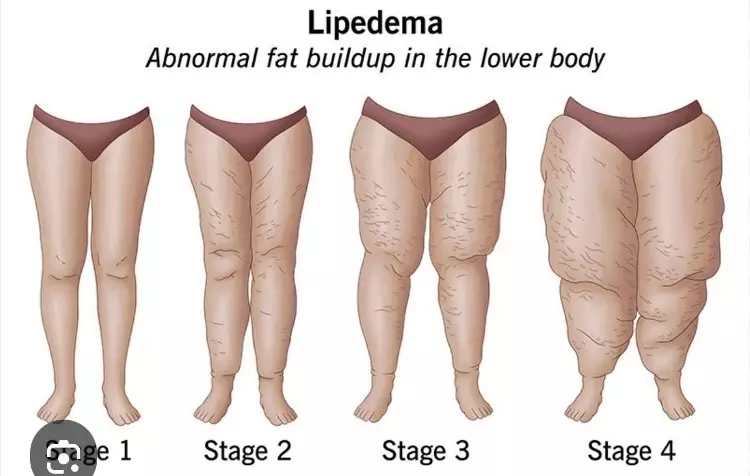
Photo Credit: from Cleveland Clinic
Most people have one main type, though patterns can overlap or progress over time. Knowing your type helps clinicians understand the extent of tissue involvement and plan appropriate care.
Stages of Lipedema (Progression)
Stages describe how lipedema advances over time, from early changes to more severe deformity and possible fluid involvement.
1. Stage 1: Skin surface is still smooth, but the underlying tissue is enlarged and may feel slightly lumpy. Pain and heaviness can already be present.
2. Stage 2: Skin becomes uneven with visible nodules under the surface. The texture feels more irregular, and areas may feel firmer or more fibrotic.
3. Stage 3: Large lobules form, creating visible deformity. The legs may look distinctly misshapen, with deeper indentations and more pronounced bumps.
4. Stage 4: Lipedema progresses to lipolymphedema, where fluid accumulation joins the fat issue. Swelling worsens, and the risk of lymphatic complications increases.
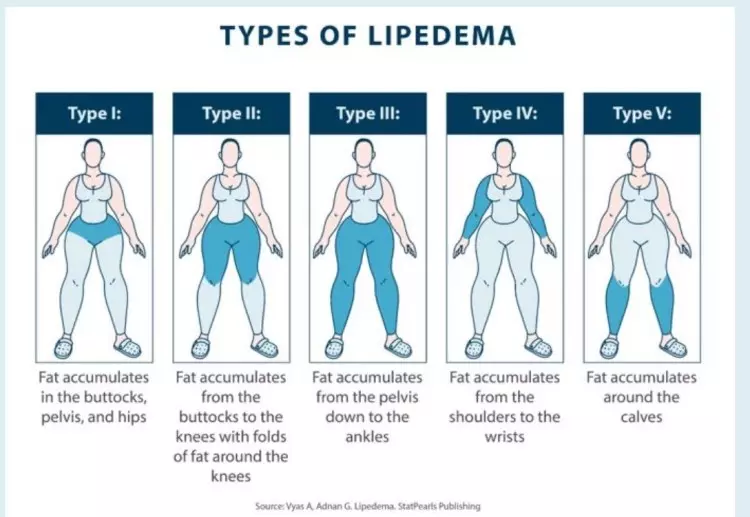
Photo Credit: from StatPearls Publishing
Progression is not guaranteed for everyone. Some people remain in earlier stages for years, while others progress more quickly, especially without proper care.
Understanding stages helps clarify why early recognition matters. The sooner lipedema is identified, the more likely it is to stay in a milder stage and respond to supportive care.
This progression is influenced by several factors, including hormones, which often play a key role in when lipedema starts and how it worsens.
Hormonal Influences:
Hormones play a key role in when lipedema starts and how it worsens. Most women notice symptoms beginning or getting worse during major hormonal shifts.
When lipedema typically appears or progresses
* Puberty – onset often around the first hormonal changes.
* Pregnancy – symptoms can start or sharply worsen.
* Menopause – fluctuating and declining hormones may trigger flare-ups.
Estrogen is the suspected driver.
Researchers suspect estrogen is central to lipedema because:
* Almost all affected people are women.
* Onset aligns with hormonal changes tied to estrogen.
* Estrogen regulates fat metabolism and distribution.
One peer-reviewed study in the International Journal of Molecular Sciences concludes that estrogen likely plays a key role in the exacerbation and progression of lipedema.
Lipedema and the Potential Role of Estrogen in Excessive Adipose Tissue Accumulation - PMC
Possible links beyond estrogen
Emerging research suggests additional connections that may influence lipedema:
* Insulin resistance – can worsen fat storage and inflammation.
* Thyroid dysfunction – around 40–44% of lipedema patients also have hypothyroidism.
https://pantea-health.de/en/lipoedema/hormones/
* Chronic inflammation – hormones and inflammation interact closely.
This hormonal-inflammatory link helps explain why lipedema often feels like a “hormonal inflammatory disease” that makes fat grow, rather than simple weight gain. Advanced Lipedema Treatment explains this as a hormonal inflammatory condition.
Other Factors, such as Stress, Trauma
Research is exploring whether stress and trauma may influence when lipedema starts or worsens, though this area is still emerging and not yet definitive.
How chronic stress may affect lipedema?
Chronic stress raises cortisol levels, which can activate inflammatory pathways in the body. Since lipedema is an inflammatory condition, prolonged stress may theoretically contribute to progression or flare-ups.
Trauma and onset
Some patients report that lipedema symptoms began after:
* Significant physical trauma (such as surgery, injury, or pregnancy).
* Major emotional trauma or prolonged psychological stress.
These are anecdotal links reported in patient communities and in some clinical observations, but they have not yet been confirmed as causal relationships in large studies. These connections are emerging but not definitive. Hormonal, inflammatory, and stress-related pathways clearly interact, but more research is needed to determine how strongly trauma and stress directly influence lipedema development.
Why Diet and Exercise Don’t Work the Same Way
With lipedema, diet and exercise still support health, but they do not reduce the fat associated with lipedema as expected.
Key realities
* Lipedema fat resists reduction despite caloric deficit.
* Weight loss is disproportionate – upper body shrinks while legs stay the same.
* Exercise improves overall health but does not target lipedema fat.
The core message
A lack of change in the lower body does not mean a lack of effort. The tissue itself is resistant, not the person. This resistance explains why many people need support beyond standard diet advice.
Management and Support:
Diet and Intermittent Fasting:
* Diets such as the Mediterranean diet, which incorporate less unhealthy carbohydrates and more plant-based options, help to lower inflammation, and many women report improvement with these types of diet. Additionally, Intermittent fasting has been shown to benefit women and help halt disease progression due to its similar inflammation-lowering effects.
Compression stockings and vibration plates have also shown improvement in some cases.
There is no cure for lipedema, but medication can help manage symptoms and support overall health. These treatments do not remove lipedema fat, but they can improve metabolism, inflammation, and comfort.
GLP-1 Receptor Agonists (Metabolic Support)
* Semaglutide (Ozempic/Wegovy)
Helps control appetite, improve blood sugar, and support weight loss in non-lipedema fat. It may also reduce inflammation.
* Liraglutide (Saxenda / Victoza)
Daily option that reduces appetite and improves blood sugar control. Supports overall metabolic health.
These medications can improve how your body feels, even if leg size does not change significantly.
Metformin (Insulin Resistance Support)
* Metformin
Improves insulin sensitivity and helps regulate blood sugar. May reduce signals that promote fat storage.
Diuretics (Fluid Support in Later Stages)
* Hydrochlorothiazide
* Furosemide (Lasix)
Help reduce fluid buildup. Typically, it is only useful in later stages when swelling includes fluid.
Hormonal Therapies (When Appropriate)
* Progesterone (Prometrium)
* Estradiol
It may help stabilize hormone changes that can worsen symptoms. Should be guided by a provider.
Anti-Inflammatory Support
* Low-dose Naltrexone (LDN) has also emerged as a possible option, although it is not for everyone
Naltrexone may help reduce inflammation and pain. Evidence is still emerging.
A hopeful path forward
Not all fat behaves the same, and recognizing lipedema is not a sign of failure. The good news is that lipedema is becoming more recognized by clinicians and those affected. Recently, it has also been recognized as a medical condition that will be assigned a specific ICD code in 2027, making it more likely to be acknowledged and receive the research it needs.
###
Your email address will not be published. Required fields are marked with *.